Unemployment
Are We Having Fun YetUnemployment is presented as a sudden family destabilizer and, ultimately, as an unexpected test of collective strength. For Kay Willis and Bub Willis, the loss of employment arrives after years in which the family believed its future was secure: Bub’s business career was advancing, Kay loved the work of raising their children, and sending all of them to college seemed a reasonable expectation rather than a remote ambition. The subsequent joblessness forces the family to reconsider what sustains a household when wages disappear, and it becomes one of the clearest demonstrations that parental presence, mutual reliance, and children’s developing competence can matter as much as income.
Security Before the Crisis
When Kay Willis and Bub Willis were raising their children, they felt safe assuming that every child could be sent to college. Their lives appeared to be proceeding along a dependable track, with Bub Willis established as a senior executive in a large corporation and Kay Willis deeply invested in motherhood. The family’s confidence rested partly on economic continuity: current work seemed capable of carrying future educational costs, and the parents did not yet have to imagine college tuition as a crisis-level problem.
That security is important because unemployment does not enter an already precarious story as a predictable condition. It interrupts an expected future. The family had not abandoned its goals or failed to plan; instead, a corporate upheaval changes the conditions under which those goals must be pursued. The reversal therefore challenges the assumption that careful planning can guarantee a family’s material path.
The Loss of Employment
Bub Willis reaches the unemployment line after a managerial shake-up following a corporate takeover. The event is impersonal in its cause but intimate in its consequences: a large organization’s restructuring removes the employment on which the family’s plans have depended. Months of job searching follow, and the search does not quickly restore stability. As time passes, the family uses up its resources and begins to feel what Kay Willis describes as the weight of the national debt.
Bub Willis eventually returns to work, but reemployment does not erase the damage. The debts accumulated during the months without work remain, and money worries make college funds a critical issue precisely when the first daughter is beginning college. Unemployment therefore has two phases in the family’s experience: the immediate shock of lost income and the prolonged afterlife of debt. The return of a paycheck changes the situation but does not return the family to its former sense of ease.
Children as Participants in Survival
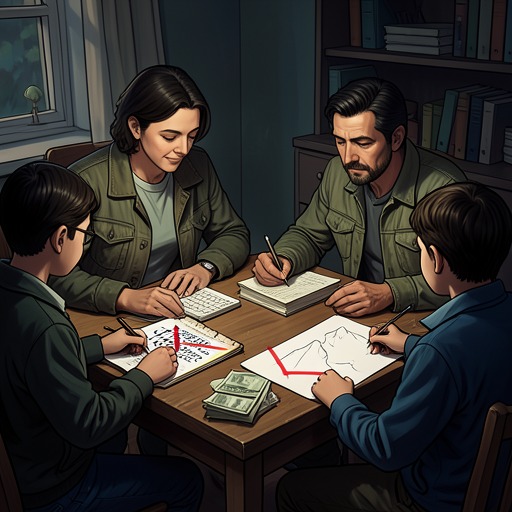
The crisis changes the children’s place within the household. When the dishwasher breaks and the family cannot afford the repair estimate, the ordinary evening arrangement of two children working in the kitchen becomes a four-child work crew. The inconvenience initially appears to be another consequence of financial strain, but Kay Willis notices that the expanded task gives the children a special opportunity to spend time together. While they load the dishwasher, manage counters, and deal with pots, she hears them discussing school events and social life.
The broken appliance thus turns unemployment’s material pressure into a scene of relationship-building. The unrepaired dishwasher is not romanticized as poverty, but it reveals that deprivation can produce forms of participation that comfort had previously concealed. The children are not merely protected dependents waiting for adults to restore normal life; they become contributors whose cooperation strengthens the family and whose conversations create an unplanned communal space.
Kay Willis makes the same point more directly in recalling the prolonged period of unemployment. Saying that a parent needs a teenager can become a genuine opportunity for growth, because children learn that difficult circumstances may require useful action rather than helplessness. She and Bub Willis needed their children in many ways, and the children surprised them with their support and cooperation. In this account, unemployment becomes formative: the children’s response to family need is linked to the confidence, responsibility, and competence they later carry into adulthood.
Presence Beyond Earning Power
The most decisive conclusion drawn from the crisis is that a father’s active presence cannot be measured by his earning power alone. Even while financial resources were depleted and college seemed newly uncertain, the children had received substantial time and attention from Bub Willis. Kay Willis believes that this investment helped them persist toward higher education. Bub Willis’s confidence in their abilities empowered them, allowing them to reach top colleges and universities even though the family’s financial route became difficult.
This contrast gives unemployment its broader significance in the book. The loss of work makes the economic definition of fatherhood visible by threatening it: if a father is valued chiefly as a provider, joblessness appears to diminish his place in the family. Kay Willis counters that assumption by emphasizing belief, time, and active involvement. Bub Willis’s contribution to his children is not cancelled by the loss of employment; indeed, the crisis clarifies the lasting value of what he had already given them.
Consequences and Long-Term Meaning
The family ultimately finds a way around the financial obstacles, and all ten children attend college. The outcome does not deny the seriousness of unemployment. Resources were exhausted, debt remained, and tuition became a pressing concern. Instead, the outcome shows that financial disruption is not identical with permanent defeat. The parents’ determination combines with the children’s creativity and cooperation to preserve the educational future the family had once taken for granted.
Kay Willis also connects the children’s later professional diversity to what they learned during the crisis. Their adult careers range from ministry and gerontology to membership in the New York Stock Exchange; the family also includes corporate officers, a teacher, a television producer, someone in sales, a successful entrepreneur, and an environmentalist. The variety of these paths gives the unemployment story an ending larger than restored income. The children do not emerge as a single type of success produced by a repaired family budget; they carry different capacities into different fields.
Unemployment consequently functions as both pressure and revelation. It exposes how quickly institutional change can threaten a carefully imagined future, how debt can outlast the original job loss, and how financial anxiety enters ordinary domestic routines. At the same time, it reveals resources that a secure household might overlook: children who can cooperate, parents who can acknowledge need, and a father whose confidence and presence remain powerful when his formal employment disappears. In the book’s account, the family survives not because unemployment is harmless, but because the crisis enlarges the meaning of contribution and makes shared responsibility visible.